





- Recherche - LLS,
- Appels à communication (recherche),
Teaching public speaking: stakes, cross-cultural perspectives, proposals
Publié le 17 juin 2026
–
Mis à jour le 24 septembre 2026
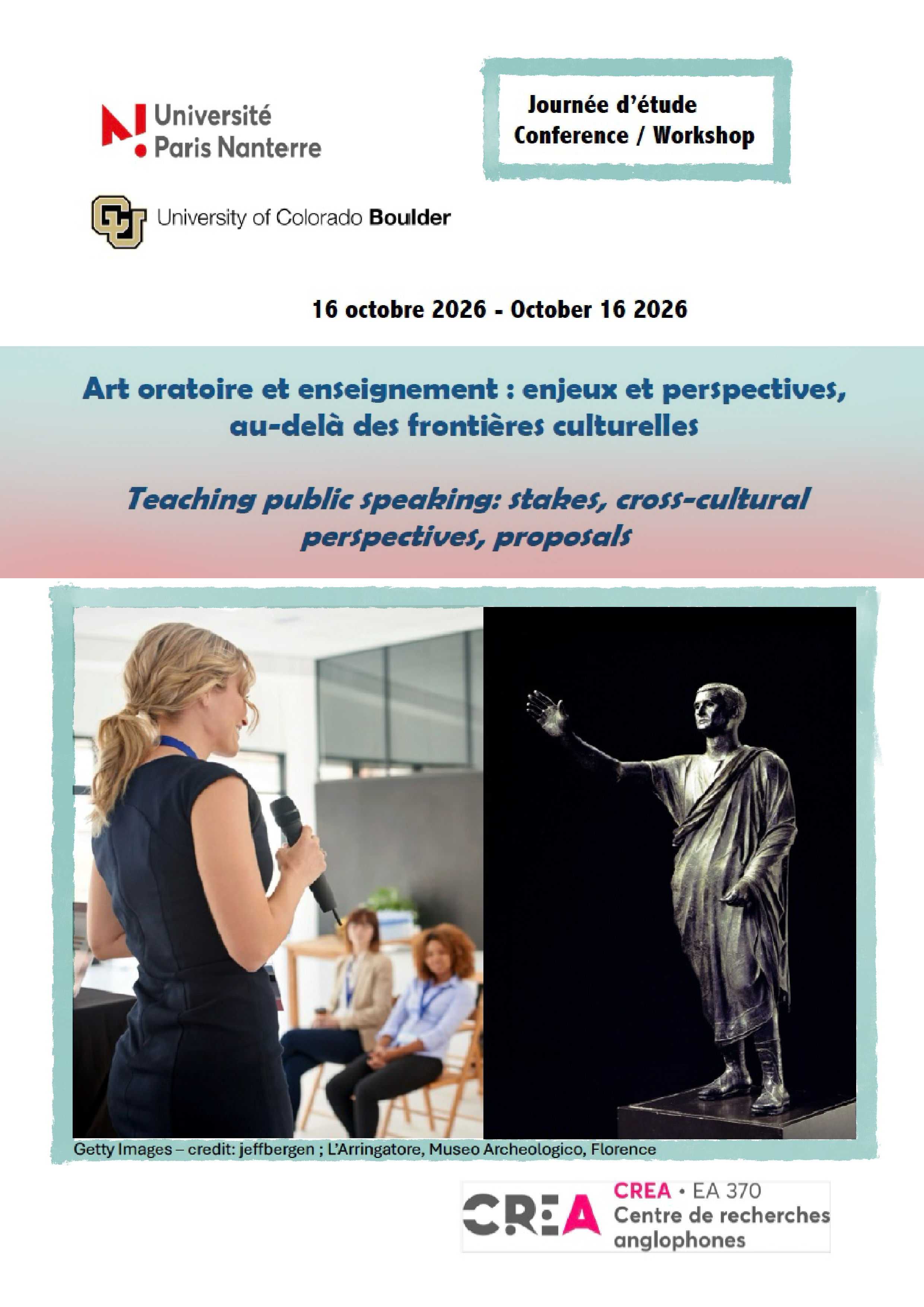
The purpose of this one-day conference is to bring together scholars in order to foster a constructive, interdisciplinary (e.g. linguistics, education sciences, discourse analysis, sociology, anthropology, communication sciences) and cross-cultural debate on the types of concepts, approaches and skills which deserve attention - and which may warrant further attention by educational policy makers - in the context of the teaching of public speaking and oratory skills in all its forms (speech, debating, other types of digital public speaking with a live or asynchronous audience, according to specific academic or professional cultures) in the contemporary context.
Date(s)
le 16 octobre 2026
The addition to the French baccalaureate in 2020 of an oral exam focusing on public speaking (“le Grand Oral”) highlights the international shift and renewed stakes of skills which lie at the intersection of oratory, rhetoric and argumentation. The implementation of this pedagogical reform has received the attention of French scholars from the fields of for instance the educational sciences, linguistics, rhetoric and discourse analysis (Guérin 2020; Dappoigny 2021; Mas et al 2021). Other studies, many with a critical slant, focus on some of the new types of public speaking practices with which numerous types of social actors are now engaging (Mariscal 2019; Corsi & Le Lay 2021; Doury & Deschellette-Frasca, to appear 2027). In parallel, there has been growing interest, from scholars working in a number of countries, in the stakes of speaking and/or rhetorical skills in relation to civic engagement. For instance, the project in France « Réinvestir la rhétorique : Pourquoi ? Comment ? » (“Reinvesting in rhetoric: Why? How?”) led by Lucie Donckier, Sarah Pariser and Benjamin Sevestre-Giraud, is echoed in the UK by the project “Speaking Citizens” (Wright 2025), in Canada by public speaking literature (Lalancette 2023) and in the U.S. by ethnological work on classroom metadiscourse at tertiary level (Boromisza-Habashi 2023) – work that posits, moreover, the “universality” of public speaking as a “for-anyone-anywhere” discourse genre” (Boromisza-Habashi & Reinig, 2018)
The purpose of this one-day conference is to bring together scholars in order to foster a constructive, interdisciplinary (e.g. linguistics, education sciences, discourse analysis, sociology, anthropology, communication sciences) and cross-cultural debate on the types of concepts, approaches and skills which deserve attention - and which may warrant further attention by educational policy makers - in the context of the teaching of public speaking and oratory skills in all its forms (speech, debating, other types of digital public speaking with a live or asynchronous audience, according to specific academic or professional cultures) in the contemporary context.
We welcome proposals for papers which may take various formats (e.g. conceptual research; teaching case studies at secondary, tertiary or continuing education level in first or second-language contexts). The conference will include a round-table debate, notably between specialists in argumentation, rhetoric and the education sciences, as well as actors in the education sector.
Submission deadline (for research papers of 30 minutes or teaching case studies of 15 minutes, in English or in French) (abstracts of approx. 250 words, to send to rossette@parisnanterre.fr and aminata.moueza-fofana@sorbonne-nouvelle.fr, with email subject “Teaching public speaking”): September 1, 2026
Plenary speaker: David Boromisza-Habashi, ethnographer of communication, University of Colorado Boulder, USA
References
Boromisza-Habashi, David, Jessica Hughes & Jennifer Malkowski. 2016. Public speaking as cultural ideal: Internationalizing the public speaking curriculum. Journal of International and Intercultural Communication 9. 20-34.
Boromisza-Habashi, David & Lydia Reinig. 2018. Speech genres and cultural value in the Anglo-American public speaking course as a site of language socialization. Journal of International and Intercultural Communication, 11 (2), 117-135.
Boromisza-Habashi, David. 2024. Tracking the transmission of culture: a cultural discourse analysis of narratives of circulation in the US undergraduate public speaking course. Journal of Multicultural Discourses 18 (4), 243-261.
Boromisza-Habashi, David & Yaqiong Fang. 2023. Public speaking goes to China : Cultural discourses of circulation. Human Communication Research 49, 24-34.
Corsi, Jean-Marc, Jean Frances, and Stéphane Le Lay. 2021. Ma thèse en 180 secondes. Quand la science devient spectacle. Vulaines sur Seine: Editions du Croquant.
Dappoigny, Camille. 2021. L’Éloquence. Administration & Éducation, 172(4), 51‑55. https://doi.org/10.3917/admed.172.0051.
Donckier de Donceel, Lucie & Benjamin Sevestre-Giraud. 2023. Nouvelle rhétorique et formation du citoyen : perspectives sur l’enseignement du discours à partir d’une université d’été. Argumentation et Analyse du Discours 30. https://doi.org/10.4000/aad.7126
Doury, Marianne & Emilie Deschellette-Frasca (à paraître) Analogy at the Podium: From Metaphor to Precedent in French Eloquence Contests. Topoi.
Doury, Marianne & Emilie Deschellette-Frasca (Eds). (à paraître avril 2027) L’éloquence en compétition: approaches critiques. Numéro special, Argumentation et Analyse du Discours 38.
Guérin, Emmanuelle. 2020. Du “petit” oral de la maison au “grand” oral de l’école… Le français aujourd’hui. Les pratiques langagières « ordinaires » des élèves. Armand Colin, 107-121.
Lalancette, Mireille. 2023. Prendre la parole et argumenter. Passer de la réflexion à l’action en personne et en ligne. Presses de l’Université du Québec.
Mariscal, Vincent. 2019. “Ma thèse en 180 secondes. Visibility as an instrument of symbolic oppression.ˮ Savoir/Agir, 48(2) : 99-105.
Mas, Marion, Catherine Nicolas & Anne Vibert (Eds.) 2021. Penser le retour de l’éloquence et de son enseignement. Recherches & Travaux 99.
Rossette-Crake, Fiona. 2024. La prise de parole et la fonction de manager. Retour sur l’exemple d’une formation suivie par des cadres de l’Éducation nationale. Communication & professionnalisation 15. https://doi.org/10.14428/rcompro.vi15.84303
Rossette-Crake, Fiona. 2016. Public Speaking and the New Oratory. Palgrave Macmillan.
Speaking Citizens: https://www.speakingcitizens.org/
Wright, Tom F. (Ed.) 2025. Oracy: The Politics of Speech Education. Cambridge University Press.
The purpose of this one-day conference is to bring together scholars in order to foster a constructive, interdisciplinary (e.g. linguistics, education sciences, discourse analysis, sociology, anthropology, communication sciences) and cross-cultural debate on the types of concepts, approaches and skills which deserve attention - and which may warrant further attention by educational policy makers - in the context of the teaching of public speaking and oratory skills in all its forms (speech, debating, other types of digital public speaking with a live or asynchronous audience, according to specific academic or professional cultures) in the contemporary context.
We welcome proposals for papers which may take various formats (e.g. conceptual research; teaching case studies at secondary, tertiary or continuing education level in first or second-language contexts). The conference will include a round-table debate, notably between specialists in argumentation, rhetoric and the education sciences, as well as actors in the education sector.
Submission deadline (for research papers of 30 minutes or teaching case studies of 15 minutes, in English or in French) (abstracts of approx. 250 words, to send to rossette@parisnanterre.fr and aminata.moueza-fofana@sorbonne-nouvelle.fr, with email subject “Teaching public speaking”): September 1, 2026
Plenary speaker: David Boromisza-Habashi, ethnographer of communication, University of Colorado Boulder, USA
References
Boromisza-Habashi, David, Jessica Hughes & Jennifer Malkowski. 2016. Public speaking as cultural ideal: Internationalizing the public speaking curriculum. Journal of International and Intercultural Communication 9. 20-34.
Boromisza-Habashi, David & Lydia Reinig. 2018. Speech genres and cultural value in the Anglo-American public speaking course as a site of language socialization. Journal of International and Intercultural Communication, 11 (2), 117-135.
Boromisza-Habashi, David. 2024. Tracking the transmission of culture: a cultural discourse analysis of narratives of circulation in the US undergraduate public speaking course. Journal of Multicultural Discourses 18 (4), 243-261.
Boromisza-Habashi, David & Yaqiong Fang. 2023. Public speaking goes to China : Cultural discourses of circulation. Human Communication Research 49, 24-34.
Corsi, Jean-Marc, Jean Frances, and Stéphane Le Lay. 2021. Ma thèse en 180 secondes. Quand la science devient spectacle. Vulaines sur Seine: Editions du Croquant.
Dappoigny, Camille. 2021. L’Éloquence. Administration & Éducation, 172(4), 51‑55. https://doi.org/10.3917/admed.172.0051.
Donckier de Donceel, Lucie & Benjamin Sevestre-Giraud. 2023. Nouvelle rhétorique et formation du citoyen : perspectives sur l’enseignement du discours à partir d’une université d’été. Argumentation et Analyse du Discours 30. https://doi.org/10.4000/aad.7126
Doury, Marianne & Emilie Deschellette-Frasca (à paraître) Analogy at the Podium: From Metaphor to Precedent in French Eloquence Contests. Topoi.
Doury, Marianne & Emilie Deschellette-Frasca (Eds). (à paraître avril 2027) L’éloquence en compétition: approaches critiques. Numéro special, Argumentation et Analyse du Discours 38.
Guérin, Emmanuelle. 2020. Du “petit” oral de la maison au “grand” oral de l’école… Le français aujourd’hui. Les pratiques langagières « ordinaires » des élèves. Armand Colin, 107-121.
Lalancette, Mireille. 2023. Prendre la parole et argumenter. Passer de la réflexion à l’action en personne et en ligne. Presses de l’Université du Québec.
Mariscal, Vincent. 2019. “Ma thèse en 180 secondes. Visibility as an instrument of symbolic oppression.ˮ Savoir/Agir, 48(2) : 99-105.
Mas, Marion, Catherine Nicolas & Anne Vibert (Eds.) 2021. Penser le retour de l’éloquence et de son enseignement. Recherches & Travaux 99.
Rossette-Crake, Fiona. 2024. La prise de parole et la fonction de manager. Retour sur l’exemple d’une formation suivie par des cadres de l’Éducation nationale. Communication & professionnalisation 15. https://doi.org/10.14428/rcompro.vi15.84303
Rossette-Crake, Fiona. 2016. Public Speaking and the New Oratory. Palgrave Macmillan.
Speaking Citizens: https://www.speakingcitizens.org/
Wright, Tom F. (Ed.) 2025. Oracy: The Politics of Speech Education. Cambridge University Press.
Mis à jour le 24 septembre 2026
Fichier joint
- Programme PDF, 486 Ko
Contact
Inscription
La journée est ouverte à tous, en présentiel ou à distance, avec une inscription préalable au lien suivant.