





- Recherche - LLS,
Séminaire OAB - ‘Minorities’ in British Museums: Between Exclusion and Misconception
Publié le 8 juin 2026
–
Mis à jour le 17 juin 2026
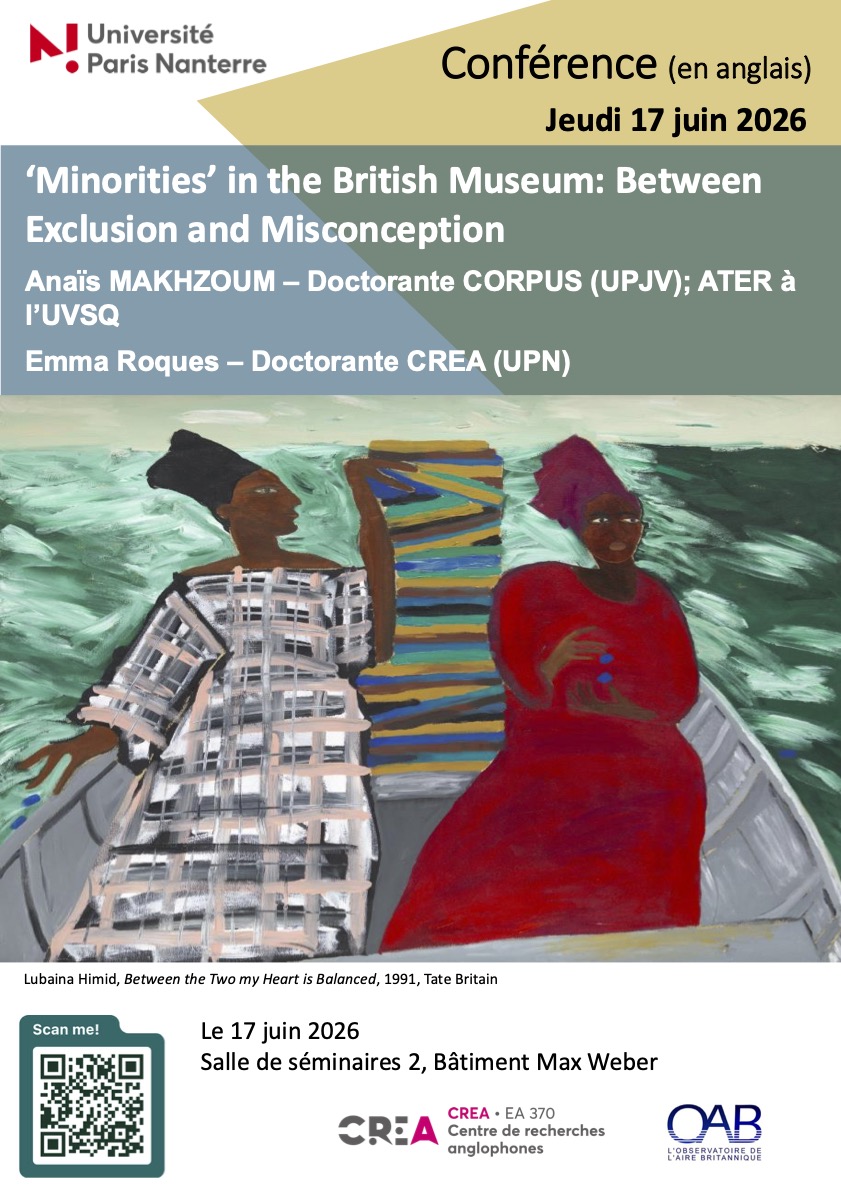
Anaïs MAKHZOUM (CORPUS,Université de Picardie Jules Verne) et Emma ROQUES (CREA, Paris Nanterre) nous présenteront leur recherche doctorale sur la représentation des minorités dans les musées et galeries d'art britanniques
Date(s)
le 17 juin 2026
17h-19h
Lieu(x)
Bâtiment Max Weber (W)
Discutante : Charlotte Gould (CREA, Paris Nanterre)
Anaïs MAKHZOUM – Doctorante CORPUS (Université de Picardie Jules Verne), ATER à l’Université de Versailles Saint-Quentin : "Black Caribbean Artists in London Museums and Art Galleries (1970s-1980s) : Between Exclusion and Collaboration"
As they were trying to navigate the rather exclusive London artistic scene of the 1970s-1980s, Caribbean visual artists faced important political and ideological transformations, in the wake of the Windrush generation’s arrival and the restrictive migration policies and growing racial tensions that ensued. Naseem Khan’s seminal report on the Arts Britain Ignores[1], published in 1976, was seen as a turning point in this regard, as it shed light on the systemic marginalisation of artists from “ethnic minorities”. However, this emerging institutional categorisation did not necessarily transform the British arts establishment, and became growingly criticised by some of these artists as it maintained them in a separate category, and strengthened a division between “traditional” and contemporary arts. Among these radical voices, the British Black Arts Movement, which emerged in the early 1980s, was instrumental in connecting the marginalisation suffered by these artists with broader political concerns, and institutional racism.
This paper will therefore address the relationship between “ethnic minority” artists – and Black Caribbean artists in particular – and London-based museums and galleries, in the 1970s-1980s. Through a focus on issues of visibility, agency, reception and political activism, we will see how this relationship oscillated between exclusion and integration, or defiance and collaboration. Our argument will shed light on a growing institutional concern for the valorisation of marginalised artists and artworks from the mid-1970s, and the consequences it had on the relationship between Black artists and mainstream galleries – such as the Tate and, to a certain extent, the Commonwealth Institute. These examples will be put into perspective with alternative institutions, sometimes directly emerging from diasporic artistic communities (Black Arts Gallery, Keskidee Arts Centre…) Through these case studies, museums and art galleries will be studied as spaces of (in)visibility, that could potentially be reclaimed by artists and activists breaking away from the arts establishment, and advocating for more community-based and artist-led initiatives.
[1] Naseem Khan, The Arts Britain Ignores: The Arts of Ethnic Minorities in Britain, Londres, 1976.
Emma ROQUES – Doctorante CREA (Paris Nanterre) : "Revising the Canon: the Role of the Women’s Art History Collective (WAHC) in Making Women Artists Visible"
The rise of feminism in England during the 1970s profoundly transformed the art world, as women artists and feminist practitioners challenged established artistic conventions and institutional norms. At the same time, feminist art historians sought to reshape the discipline by questioning the gendered hierarchies that structured artistic production, genres, and historical narratives. Within this context, and under the broader framework of the Women’s Liberation Movement (WLM), numerous feminist collectives emerged. Among them was the Women’s Art History Collective (WAHC), a group of art history students and artists dedicated to critically examining the construction of art history, particularly the historical marginalization and invisibility of women artists. Influenced by the political turmoil, students and feminist revendications, along with the emergence of new theories in social sciences and art history, the collective inscribe itself into the New Art History Movement. The WAHC challenged the positivist and traditional conceptions of art history in England, within its very institutions such as the Courtauld Institute, London art schools and even the National Gallery.
This paper seeks to initiate a reflection on feminist collectives within the art world, particularly in the field of art history during the 1970s. Their role appears crucial in advancing the recognition and consideration of women artists within the broader history of art. For centuries, however, women were largely relegated to marginal positions, often viewed as muses, assistants, or minor painters rather than as artists in their own right. The WAHC sought to challenge this paradigm by integrating women into a more comprehensive narrative of art history, highlighting the relationships, exchanges, and mutual influences between male and female artists. The collective also drew attention to the material conditions under which women artists worked, demonstrating that their socio-economic circumstances differed significantly from those of men.
Anaïs MAKHZOUM – Doctorante CORPUS (Université de Picardie Jules Verne), ATER à l’Université de Versailles Saint-Quentin : "Black Caribbean Artists in London Museums and Art Galleries (1970s-1980s) : Between Exclusion and Collaboration"
As they were trying to navigate the rather exclusive London artistic scene of the 1970s-1980s, Caribbean visual artists faced important political and ideological transformations, in the wake of the Windrush generation’s arrival and the restrictive migration policies and growing racial tensions that ensued. Naseem Khan’s seminal report on the Arts Britain Ignores[1], published in 1976, was seen as a turning point in this regard, as it shed light on the systemic marginalisation of artists from “ethnic minorities”. However, this emerging institutional categorisation did not necessarily transform the British arts establishment, and became growingly criticised by some of these artists as it maintained them in a separate category, and strengthened a division between “traditional” and contemporary arts. Among these radical voices, the British Black Arts Movement, which emerged in the early 1980s, was instrumental in connecting the marginalisation suffered by these artists with broader political concerns, and institutional racism.
This paper will therefore address the relationship between “ethnic minority” artists – and Black Caribbean artists in particular – and London-based museums and galleries, in the 1970s-1980s. Through a focus on issues of visibility, agency, reception and political activism, we will see how this relationship oscillated between exclusion and integration, or defiance and collaboration. Our argument will shed light on a growing institutional concern for the valorisation of marginalised artists and artworks from the mid-1970s, and the consequences it had on the relationship between Black artists and mainstream galleries – such as the Tate and, to a certain extent, the Commonwealth Institute. These examples will be put into perspective with alternative institutions, sometimes directly emerging from diasporic artistic communities (Black Arts Gallery, Keskidee Arts Centre…) Through these case studies, museums and art galleries will be studied as spaces of (in)visibility, that could potentially be reclaimed by artists and activists breaking away from the arts establishment, and advocating for more community-based and artist-led initiatives.
[1] Naseem Khan, The Arts Britain Ignores: The Arts of Ethnic Minorities in Britain, Londres, 1976.
Emma ROQUES – Doctorante CREA (Paris Nanterre) : "Revising the Canon: the Role of the Women’s Art History Collective (WAHC) in Making Women Artists Visible"
The rise of feminism in England during the 1970s profoundly transformed the art world, as women artists and feminist practitioners challenged established artistic conventions and institutional norms. At the same time, feminist art historians sought to reshape the discipline by questioning the gendered hierarchies that structured artistic production, genres, and historical narratives. Within this context, and under the broader framework of the Women’s Liberation Movement (WLM), numerous feminist collectives emerged. Among them was the Women’s Art History Collective (WAHC), a group of art history students and artists dedicated to critically examining the construction of art history, particularly the historical marginalization and invisibility of women artists. Influenced by the political turmoil, students and feminist revendications, along with the emergence of new theories in social sciences and art history, the collective inscribe itself into the New Art History Movement. The WAHC challenged the positivist and traditional conceptions of art history in England, within its very institutions such as the Courtauld Institute, London art schools and even the National Gallery.
This paper seeks to initiate a reflection on feminist collectives within the art world, particularly in the field of art history during the 1970s. Their role appears crucial in advancing the recognition and consideration of women artists within the broader history of art. For centuries, however, women were largely relegated to marginal positions, often viewed as muses, assistants, or minor painters rather than as artists in their own right. The WAHC sought to challenge this paradigm by integrating women into a more comprehensive narrative of art history, highlighting the relationships, exchanges, and mutual influences between male and female artists. The collective also drew attention to the material conditions under which women artists worked, demonstrating that their socio-economic circumstances differed significantly from those of men.
Mis à jour le 17 juin 2026