





- Recherche - LLS,
Ghost Memories: Photographic Memory and Diasporic Imaginings
Publié le 24 mars 2026
–
Mis à jour le 10 avril 2026
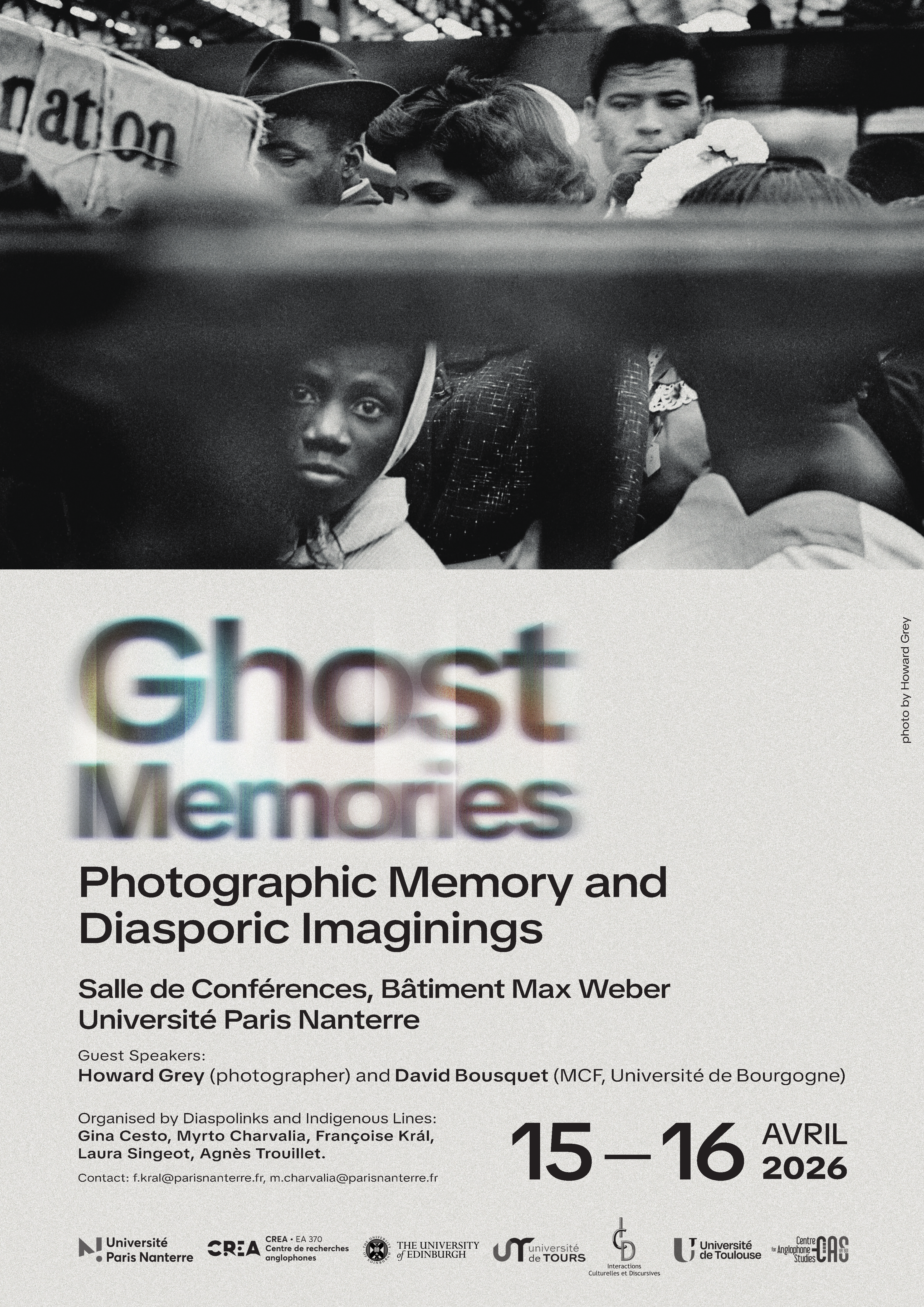
Organised by Diaspolinks and Indigenous Lines
Date(s)
du 15 avril 2026 au 16 avril 2026
Lieu(x)
Bâtiment Max Weber (W)
Salle de Conférences
La conférence sera également accessible à partir du lien suivant : https://events.teams.microsoft.com/event/573b2475-3110-4759-b4d4-b2eeb321692d@a37861db-695a-43bf-9e29-5179a055805b
La conférence sera également accessible à partir du lien suivant : https://events.teams.microsoft.com/event/573b2475-3110-4759-b4d4-b2eeb321692d@a37861db-695a-43bf-9e29-5179a055805b
Long before the era of digital cameras, telephones and other means of recording memories, photos were a rite of passage in the diasporic journey. Whether they be photos immortalizing faraway places or new encounters, images which testified to the comfort of a new home, or photos for which people posed, sporting carefully chosen outfits to make a statement about their new-found prosperity, as in Ernest Dyche’s photos of the South Asian and Caribbean diasporas, photos remain part and parcel of the individual and collective memory of diasporas.
However, these material fragments of fleeting moments were themselves subject to loss or destruction. Sometimes it may even be that the result one had anticipated turned out to be a disappointment due to one technical glitch or other. When he took photos of the newly arrived Windrushers at Waterloo, Howard Grey did not suspect that it would take some sixty years for some of his overexposed negatives to be developed. In 2014, a new technique allowed him to retrieve the long-lost figures in his photos.
Taking its cue from this particular example, the conference will investigate the presence of photos with regard to the shaping of individual and collective memories of diasporas.
The conference will investigate the role played by these photos in the creation of an individual as well as a collective memory of the home country, one which either “refossilizes” the fragment of the lost homeland or takes account of the newly redefined diasporan, paying particular attention to the photos’ haunting quality. From the moment they are taken, and long before they are developed and printed, photos already haunt those who pose for them and the photographic memories which they subsequently become sometimes continue long after they are lost or destroyed.
REFERENCES:
ADORNO, Theodor W. Aesthetic Theory. Ed. Gretel Adorno and Rolf Tiedemann. Trans. Christina Lenhardt. London and Boston: Routledge and Kegan Paul, 1984 (1970).
APPANAH, Nathacha. La mémoire délavée. Paris : Gallimard, 2023.
BARTHES, Roland. La chambre claire: Note sur la photographie. Paris: Seuil, 1980.
BERGER, John. Ways of Seeing. British broadcasting corporation and Penguin Books, 1972.
DERRIDA, Jacques. Les morts de Roland Barthes. Poétique, Paris, 1981.
DERRIDA, Jacques et Marie-Françoise Plissart. Droit de regards. Paris : Éditions de Minuit, 1985.
DERRIDA, Jacques. Spectres de Marx. Paris : Gallilée, 1993.
DERRIDA, Jacques. Mal d’archives, une impression freudienne. Paris : Galliée, 1995.
DIDI-HUBERRMAN, George. L'image survivante. Histoire de l'art et temps des fantômes selon Aby Warburg, Paris, Éditions de Minuit, 2002.
HIRSCH, Marianne. Family frames, Photography, Narrative and Postmemory. Cambridge: Harvard University Press, 1997.
SONTAG, Susan. On Photography. New York: Farrar, Straus and Giroux. 1977.
However, these material fragments of fleeting moments were themselves subject to loss or destruction. Sometimes it may even be that the result one had anticipated turned out to be a disappointment due to one technical glitch or other. When he took photos of the newly arrived Windrushers at Waterloo, Howard Grey did not suspect that it would take some sixty years for some of his overexposed negatives to be developed. In 2014, a new technique allowed him to retrieve the long-lost figures in his photos.
Taking its cue from this particular example, the conference will investigate the presence of photos with regard to the shaping of individual and collective memories of diasporas.
The conference will investigate the role played by these photos in the creation of an individual as well as a collective memory of the home country, one which either “refossilizes” the fragment of the lost homeland or takes account of the newly redefined diasporan, paying particular attention to the photos’ haunting quality. From the moment they are taken, and long before they are developed and printed, photos already haunt those who pose for them and the photographic memories which they subsequently become sometimes continue long after they are lost or destroyed.
REFERENCES:
ADORNO, Theodor W. Aesthetic Theory. Ed. Gretel Adorno and Rolf Tiedemann. Trans. Christina Lenhardt. London and Boston: Routledge and Kegan Paul, 1984 (1970).
APPANAH, Nathacha. La mémoire délavée. Paris : Gallimard, 2023.
BARTHES, Roland. La chambre claire: Note sur la photographie. Paris: Seuil, 1980.
BERGER, John. Ways of Seeing. British broadcasting corporation and Penguin Books, 1972.
DERRIDA, Jacques. Les morts de Roland Barthes. Poétique, Paris, 1981.
DERRIDA, Jacques et Marie-Françoise Plissart. Droit de regards. Paris : Éditions de Minuit, 1985.
DERRIDA, Jacques. Spectres de Marx. Paris : Gallilée, 1993.
DERRIDA, Jacques. Mal d’archives, une impression freudienne. Paris : Galliée, 1995.
DIDI-HUBERRMAN, George. L'image survivante. Histoire de l'art et temps des fantômes selon Aby Warburg, Paris, Éditions de Minuit, 2002.
HIRSCH, Marianne. Family frames, Photography, Narrative and Postmemory. Cambridge: Harvard University Press, 1997.
SONTAG, Susan. On Photography. New York: Farrar, Straus and Giroux. 1977.
Mis à jour le 10 avril 2026
Keynote speakers
Howard Grey (photographer)
David Bousquet (MCF, Université Bourgogne Europe)
David Bousquet (MCF, Université Bourgogne Europe)
Scientific committee
Françoise Král
Agnès Trouillet
Corinne Bigot
Sam Coombes
Laura Singeot
Agnès Trouillet
Corinne Bigot
Sam Coombes
Laura Singeot
Organizing committee
Françoise Král
Agnès Trouillet
Corinne Bigot
Sam Coombes
Laura Singeot
Gina Cesto
Myrto Charvalia
Agnès Trouillet
Corinne Bigot
Sam Coombes
Laura Singeot
Gina Cesto
Myrto Charvalia
Institutional partners
University of Edinburgh
Université de Tours (ICD, UR 6297)
Université de Toulouse Jean Jaurès
Université de Tours (ICD, UR 6297)
Université de Toulouse Jean Jaurès